No company has to prove a hand soap is hypoallergenic before printing the word on the bottle. The FDA has never defined it, and the agency notes that dermatologists say it has very little meaning. So when your knuckles itch and redden a day or two after washing, the soap with the reassuring label is a fair first suspect, especially if parfum shows up in its ingredient list.
Skip the label and read the ingredients. A hypoallergenic hand soap that helps fragrance-allergic skin is fragrance-free on its ingredient list. It leaves out perfume and essential oils and skips the named fragrance allergens you'll find further down this page. When you're away from a sink, a gentle, non-irritating hypoallergenic hand soap in an unscented, rinse-free formula keeps your hands clean without adding a new scent to your day.
TL;DR Quick Answers
Hypoallergenic hand soap
Hypoallergenic hand soap is soap its maker claims causes fewer allergic reactions. The FDA has no federal definition for the term and doesn't require companies to prove it, so the ingredient list tells you more than the label does.
What to look for on the ingredient list:
Fragrance-free rather than unscented, since unscented soaps can hide a masking fragrance
No parfum, aroma, or essential oils
None of the named fragrance allergens, such as linalool, limonene, or geraniol
No SLS or alcohol, which strip the skin's natural moisture barrier
A short ingredient list
Outside screening, such as the NEA Seal of Acceptance
Best fit by situation:
At the sink: a fragrance-free gentle cleanser
Away from water: an unscented, rinse-free, plant-based soap that skips the wet-dry cycle
Before daily use: a patch test on your inner forearm
If rashes keep coming back: a dermatologist's patch test to pin down your triggers
Bottom line: Skip the label. Read the ingredients.
Top Takeaways
"Hypoallergenic" has no federal definition in the US, so any company can print it.
Fragrance is one of the most common causes of allergic contact dermatitis in adults and children.
Unscented products can hide a masking fragrance. Fragrance-free is the better label to start from, even though the law doesn't define it either.
Soaps made with natural ingredients or essential oils can carry the same allergens as synthetic perfume.
Only a dermatologist's patch test can confirm which fragrance chemicals you react to.
What "Hypoallergenic" Really Means on a Hand Soap Label
A hypoallergenic label tells you the maker believes the product causes fewer allergic reactions. That's all it tells you. The FDA says no federal standard backs the claim, so the word means whatever the company printing it wants it to mean, and nobody has to send the agency proof.
That's how a scented soap ends up wearing the word. Some commercial foam soaps sold to schools and offices carry both a hypoallergenic claim and a floral scent. When UCSF dermatologists checked popular hand sanitizers, most of the ones marketed as hypoallergenic still contained at least one common allergen.
The FDA does require an ingredient list on cosmetics. If you're allergic to fragrance, become an ingredient detective, because that list is the only part of the bottle that has to tell you the truth.
How Fragrance Triggers Allergic Contact Dermatitis on Your Hands
Once your immune system decides a fragrance chemical is a threat, it remembers. Every later contact can set off allergic contact dermatitis, an itchy red rash that can blister or crack. It usually appears a day or two after exposure, which is why so few people connect it to their soap.
Your hands get more exposure than any other part of your body. You wash them several times a day, and damaged skin lets allergens through more easily. According to a dermatologist review in Cutis, fragranced soap can also leave a residue on your palms that you carry to thinner skin, like your eyelids, every time you rub your eyes.
Fragrance Allergy or Irritant Dermatitis?
The two look almost identical and often show up together. Irritant dermatitis comes from wear and tear, such as hot water and the constant wet-dry cycle of washing. Allergic dermatitis is your immune system reacting to one specific ingredient. A dermatologist's patch test is the only way to tell which one you're dealing with and which fragrance chemicals you'll need to avoid.
Hypoallergenic vs Fragrance-Free vs Unscented Hand Soap
US law doesn't define any of these terms, but they still point in different directions. An unscented soap is supposed to smell like nothing, and some brands get there by adding a masking fragrance to cover the smell of the base ingredients. Fragrance-free is the better label to start from, although even that one isn't a guarantee.
Hypoallergenic. The maker claims fewer reactions. Fragrance can still be in the bottle, so read the whole ingredient list.
Unscented. The soap shouldn't smell like anything, but it can still contain fragrance, including masking agents. Look for fragrance or parfum on the label.
Fragrance-free. The maker shouldn't have added any fragrance. A 2026 clinical review in JCAD cites a study that still found linalool, limonene, and geraniol in products labeled this way, so check the list against a trusted database.
Natural or botanical. The ingredients come from plants, and essential oils often bring fragrance along with them. Look for essential oils and named allergens.
The National Eczema Association holds products to a stricter standard for its Seal of Acceptance. Seal products can't contain added fragrance or masking agents.
Ingredient Red Flags for Fragrance-Allergic Hands
If you react to fragrance, treat these names as stop signs. Read the full list, because fragrance can sit anywhere in it.
Fragrance, parfum, aroma, or perfume
Essential oils, such as lavender, tea tree, and citrus peel oils
Linalool, limonene, citronellol, geraniol, eugenol, cinnamal, coumarin, and hydroxycitronellal
Myroxylon pereirae, also sold as balsam of Peru
Two other soap ingredients cause reactions in some people even though they aren't fragrances. Methylisothiazolinone is a preservative that a 2026 UK survey still found in liquid hand soaps. Cocamidopropyl betaine makes many soaps foam, and researchers writing in the journal Dermatitis ranked it among the top allergens in soaps that need water.
The full list runs much longer. Dermatologists writing in Cutis counted 162 documented fragrance allergens, and 80 of them are essential oils. US labels only have to say "fragrance," so most of those names never appear on the bottle.
Why "Natural" Doesn't Mean Fragrance-Safe
Plant-based and fragrance-free aren't the same thing. Essential oils carry many of the same sensitizing chemicals as synthetic perfume, just from a different source. A 2016 pediatric study found that hygiene products labeled hypoallergenic or all-natural were still a meaningful source of fragrance exposure for kids. If you've been comparing organic hand soap options, check those labels for essential oils too.
How to Choose a Hypoallergenic Hand Soap That Actually Helps
Ignore the claims on the front of the bottle.
Look for fragrance-free rather than unscented.
Read the whole ingredient list for the red-flag names above.
Pick the soap with the shorter ingredient list, since every extra ingredient is one more thing that could cause a reaction.
Lean on outside screening, like the NEA Seal of Acceptance or the ACDS CAMP database, which a patch-testing dermatologist can set up for you.
Try a new soap on your inner forearm for a few days before you use it every day.
Options Ranked for Fragrance-Sensitive Hands
Fragrance-free gentle liquid cleanser. Keep this one at the sink. Choose a short ingredient list with no parfum or essential oils.
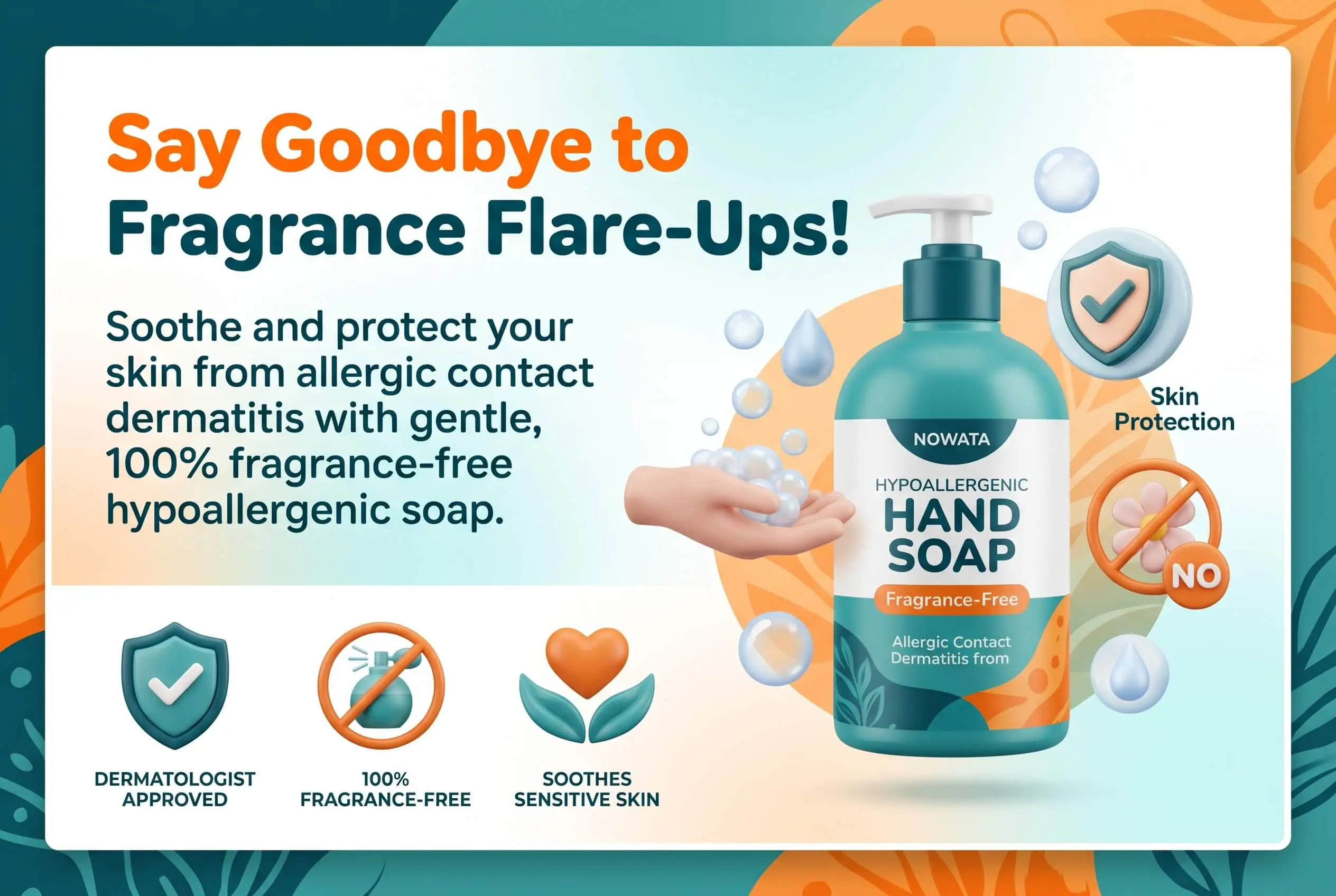
Unscented rinse-free, plant-based soap. This one is for the times you can't get to a sink. Dr. Ruslan Maidans, a dentist, and Dr. Yalda Shahriari, a biomedical engineer, built NOWATA around clumping technology. Its plant and mineral ingredients bind to dirt and germs so you can brush them off, and you skip the water and the wet-dry cycle that wears down sensitive skin. The founders left out SLS, alcohol, synthetic fragrances, dyes, parabens, phthalates, and PFAS, and in independent lab testing the formula physically removed over 99.9%* of test germs. Buy the Unscented version rather than Lavender, and patch test it first, which NOWATA itself recommends for anyone with known allergies. You can also see how waterless hand soap compares to soap and water.
Fragrance-free syndet bar. Syndet bars clean with synthetic detergents and usually treat reactive hands more gently than old-fashioned soap.
Fragrance-free sanitizer. Save it for when nothing else is around, because it's harder on dry or cracked skin. If sanitizer gels sting, a non-irritating hand sanitizer alternative may suit you better.
How they compare for fragrance-allergic hands:
A fragrance-free liquid cleanser carries little fragrance risk and suits everyday use at home or work.
An unscented rinse-free soap is just as low-risk and works best on the go.
A fragrance-free syndet bar is a gentle pick for the sink or the shower.
A fragrance-free sanitizer avoids scent but dries skin out, so keep it for emergencies.
Daily Hand-Care Routine for Fragrance Contact Dermatitis
The American Academy of Dermatology recommends the first three steps here.
Wash in lukewarm water instead of hot.
Pat your hands until they're only slightly damp.
Right away, rub in a thick hand cream or ointment labeled fragrance-free and dye-free.
Wear cotton-lined gloves for dishes and cleaning.
Check everything else your hands touch, including lotion, dish soap, sanitizer, laundry detergent, and anything your partner uses.
Fragrance doesn't stay in the bathroom. The Cutis review links diffusers, scented candles, and room deodorizers to airborne contact dermatitis, so add those to your list. If you're working on the air at home too, these simple air filter fixes for fewer allergies are worth a look.
When to See a Dermatologist
Book a visit if the rash sticks around after you've removed the products you suspect, or if it starts to crack, bleed, or look infected. Ask about patch testing. It's the only reliable way to learn exactly which fragrance chemicals you need to avoid.
"I spent two winters buying hand soap by the front of the bottle, and my knuckles split anyway. I blamed the dry air. What finally changed things was an evening at the kitchen counter with every bottle in the house turned around. Four of the five I'd bought for being gentle listed parfum or an essential oil. I moved to a fragrance-free cleanser at the sink and kept an unscented rinse-free soap in my bag, and within a few weeks the flares came less often. The front of a bottle tells you how the company wants you to feel about it, while the ingredient list tells you what's going on your skin. If you're allergic to fragrance, trust the list."
7 Essential Resources
These are the sources I go back to when a label claim doesn't add up. Doctors and dermatology researchers wrote or reviewed every one of them.
FDA: "Hypoallergenic" Cosmetics. The FDA explains that no federal standard backs the word and points shoppers to the ingredient list instead.
Cutis: Navigating Allergic Contact Dermatitis to Fragrance. Dermatologists explain why "unscented" labels mislead and point out where fragrance hides around the house.
JCAD: Fragrance Safety in Atopic Dermatitis. This October 2026 clinical review compares unscented and fragrance-free labels and makes the case that natural doesn't mean safe.
UCSF Study on "Hypoallergenic" Hand Sanitizers. Dr. Carina Woodruff, the UCSF dermatologist behind the study, explains how hypoallergenic claims often hide common allergens.
National Eczema Association Seal of Acceptance Directory. Independent physician reviewers screen the cleansers and moisturizers listed here against a set of excluded ingredients.
American Contact Dermatitis Society CAMP. Dermatologists use this database after patch testing to build a list of products each patient can safely use.
American Academy of Dermatology: Dry Skin Relief From Handwashing. Board-certified dermatologists show how to wash and moisturize hands that are already dry or cracked.
Supporting Statistics
UCSF dermatologists studied top-reviewed hand sanitizers from major US retailers and found that 70% of products marketed as "hypoallergenic" contained at least one common allergen. They also judged nearly 1 in 5 of the marketing claims on those products misleading. (UCSF study interview)
Between 1% and 4.5% of the general population has a fragrance allergy, according to a 2026 clinical review in the Journal of Clinical and Aesthetic Dermatology. That works out to millions of people. (JCAD)
Dermatologists writing in Cutis counted 162 documented fragrance allergens, and 80 of them are essential oils. US labels only need to say "fragrance," so shoppers rarely see any of those names. (Cutis)
Final Thoughts and Opinion
I'll say it plainly. The word "hypoallergenic" hasn't done fragrance-allergic shoppers any favors. It reads like a promise but carries no legal weight, and because it shows up on scented bottles as often as unscented ones, it teaches people to trust the wrong side of the label.
What works is slower and less exciting. Turn the bottle over and choose fragrance-free over unscented. Treat essential oils the way you'd treat perfume, since chemically they're often close relatives. And if the rash keeps coming back anyway, get patch tested so you're working from your actual triggers instead of guesses.
My recommendation is the hypoallergenic hand soap with the shortest, plainest ingredient list you can find, plus an unscented rinse-free option for days when a sink isn't nearby. Your hands will do better without the scent.
Frequently Asked Questions
Is hypoallergenic hand soap the same as fragrance-free?
No. A hypoallergenic hand soap only carries the maker's claim that it causes fewer reactions, and many still contain parfum. A fragrance-free soap shouldn't have any added fragrance. US law doesn't define either term, so read the ingredient list whichever label you see.
Can unscented hand soap still cause a fragrance allergy?
Yes. Unscented means the soap has no noticeable smell, and some brands get there by adding a masking fragrance. That masking agent can still trigger allergic contact dermatitis, so look for fragrance-free and confirm it on the ingredient list.
What ingredients should I avoid if I'm allergic to fragrance?
Start with fragrance, parfum, aroma, perfume, and essential oils. Then watch for linalool, limonene, citronellol, geraniol, eugenol, cinnamal, coumarin, hydroxycitronellal, and balsam of Peru. A dermatologist's patch test shows which of these matter for you.
Are natural or essential-oil soaps safe for fragrance allergies?
Not automatically. Essential oils contain many of the same sensitizing chemicals as synthetic fragrance, and 80 of the 162 documented fragrance allergens are essential oils. If you're fragrance-allergic, treat an essential oil the way you'd treat perfume.
How do I know if my hand rash is caused by fragrance?
You can't tell for certain on your own, because fragrance allergy and irritant dermatitis look so much alike. A dermatologist can patch test you to find the specific chemicals behind it. Until then, switching to fragrance-free products is a sensible first step.
Find a Hypoallergenic Hand Soap Your Skin Can Live With
Your hands shouldn't have to pay for a scent you never wanted. Next time you shop, turn the bottle over before it goes in the cart and choose fragrance-free over unscented. Patch test anything new for a few days. For the times you'll be far from a sink, NOWATA Unscented cleans your hands without water and without adding fragrance to them.