TL;DR Quick Answers
What are the air filter sizes for small commercial office HVAC?
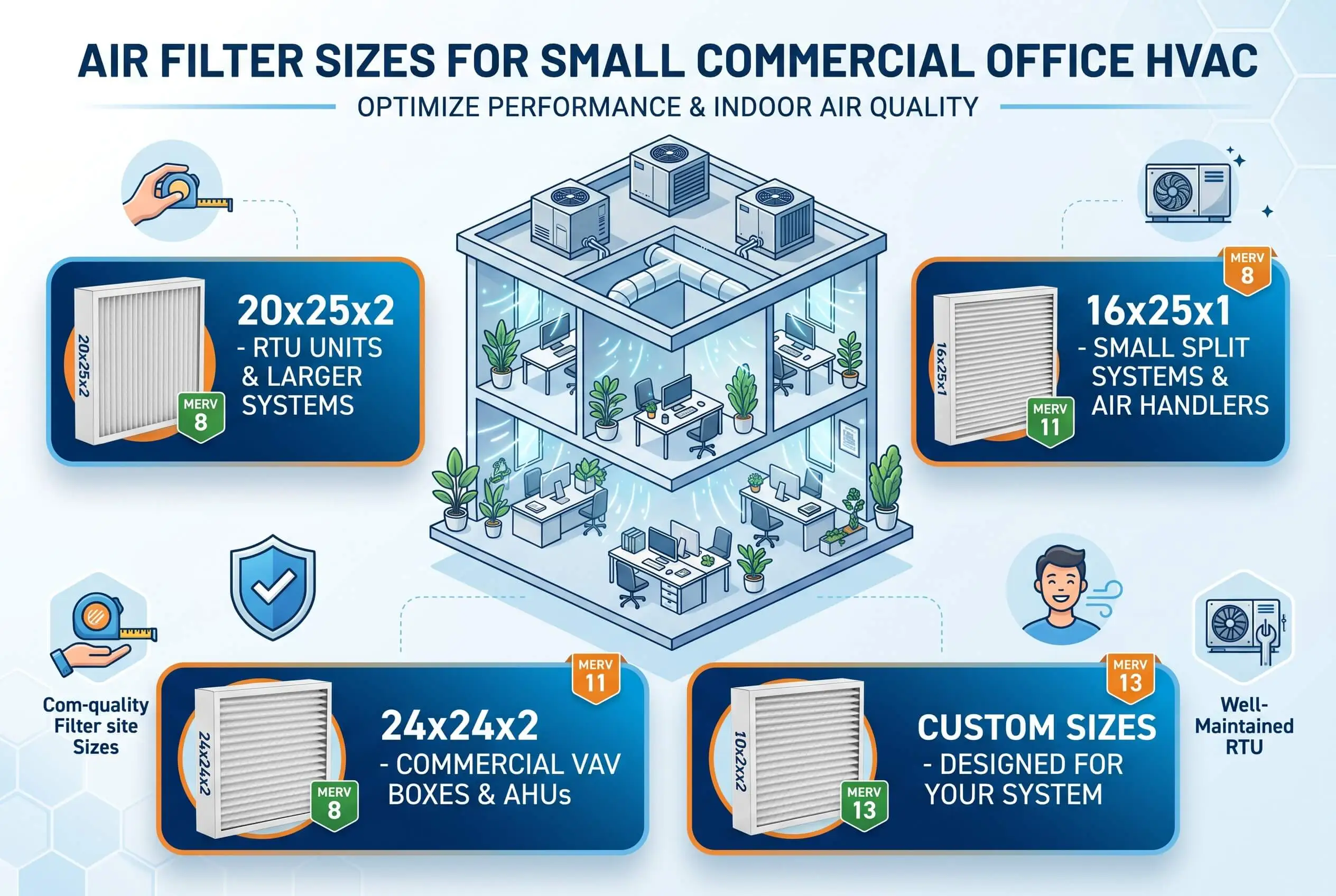
The most common nominal sizes for small commercial office HVAC are 16x25x4, 20x20x4, and 20x25x4 for typical 3 to 10 ton rooftop and split systems. Light commercial systems with 1-inch racks usually take 16x25x1 or 20x25x1, and ceiling cassette returns commonly use 24x24x2. Always confirm the size by measuring the existing filter or the slot opening before ordering, and order by nominal size.
Most common: 16x25x4, 20x20x4, 20x25x4
1-inch rack systems: 16x25x1, 20x25x1
Ceiling cassette returns: 24x24x2
Recommended MERV: 13 where the system supports it, 8 to 11 floor
Replacement cadence: every 60 to 90 days
Top Takeaways
The three most common small office filter sizes are 16x25x4, 20x20x4, and 20x25x4.
Nominal size is the printed size on the frame; actual size is roughly a quarter to a half inch smaller per dimension.
MERV 13 is the EPA-recommended target where the system supports it, with MERV 8 to 11 as the realistic floor for older units.
A correctly sized lower-MERV filter outperforms an oversized or forced-fit higher-MERV filter, every time.
Replace small office filters every 60 to 90 days, and check them monthly during peak cooling and heating seasons.
Why Filter Size Matters More in Small Commercial Offices
An incorrectly sized filter changes how the whole HVAC system behaves. The consequences land squarely on the people sitting at the desks under it.
Bypass: an undersized filter leaves a gap, and unfiltered air slips straight around the frame, dropping dust and pollen back into the supply duct.
Pressure drop: an oversized filter forced into a smaller slot bends, crimps, and chokes airflow, which makes the blower motor work harder and run longer.
Coil fouling: when bypass and pressure drop combine, the evaporator coil collects the dust the filter was supposed to catch. A coil cleaning service call costs roughly forty times what a correctly sized filter does.
For a small office, all of that shows up the same way: tenant comfort complaints, a utility bill that creeps up quietly, and an HVAC unit that loses years of useful life nobody planned to lose. The air filter is one of the few mechanical components in the whole building that anyone on staff can swap in under five minutes. That makes the size decision one of the highest-leverage maintenance calls a property manager makes all year.
Standard Filter Sizes for Small Office HVAC Systems
Most small commercial offices run one of two setups. A packaged rooftop unit on the roof, or a split system with the air handler tucked into a mechanical closet. Both pull from a short list of common nominal sizes.
16x25x4: standard for most 3 to 5 ton split systems serving offices in the 1,500 to 3,000 square foot range.
20x20x4: common in compact rooftop units on smaller standalone offices and end-cap retail.
20x25x4: the workhorse for 5 to 10 ton rooftop units on offices in the 3,000 to 8,000 square foot range.
16x25x1 and 20x25x1: light commercial split systems with 1-inch filter racks, often in older buildings.
24x24x2: drop-in ceiling cassette returns, common in build-out office suites with grid ceilings.
Older office properties often use non-standard cabinets, and in those cases a custom-cut filter built to the exact slot is the right answer. For the full chart of every standard nominal size we manufacture, including thick media options for pleated furnace filters, see the complete Filterbuy air filter size guide.
Nominal vs Actual Size: The Number One Office Sizing Mistake
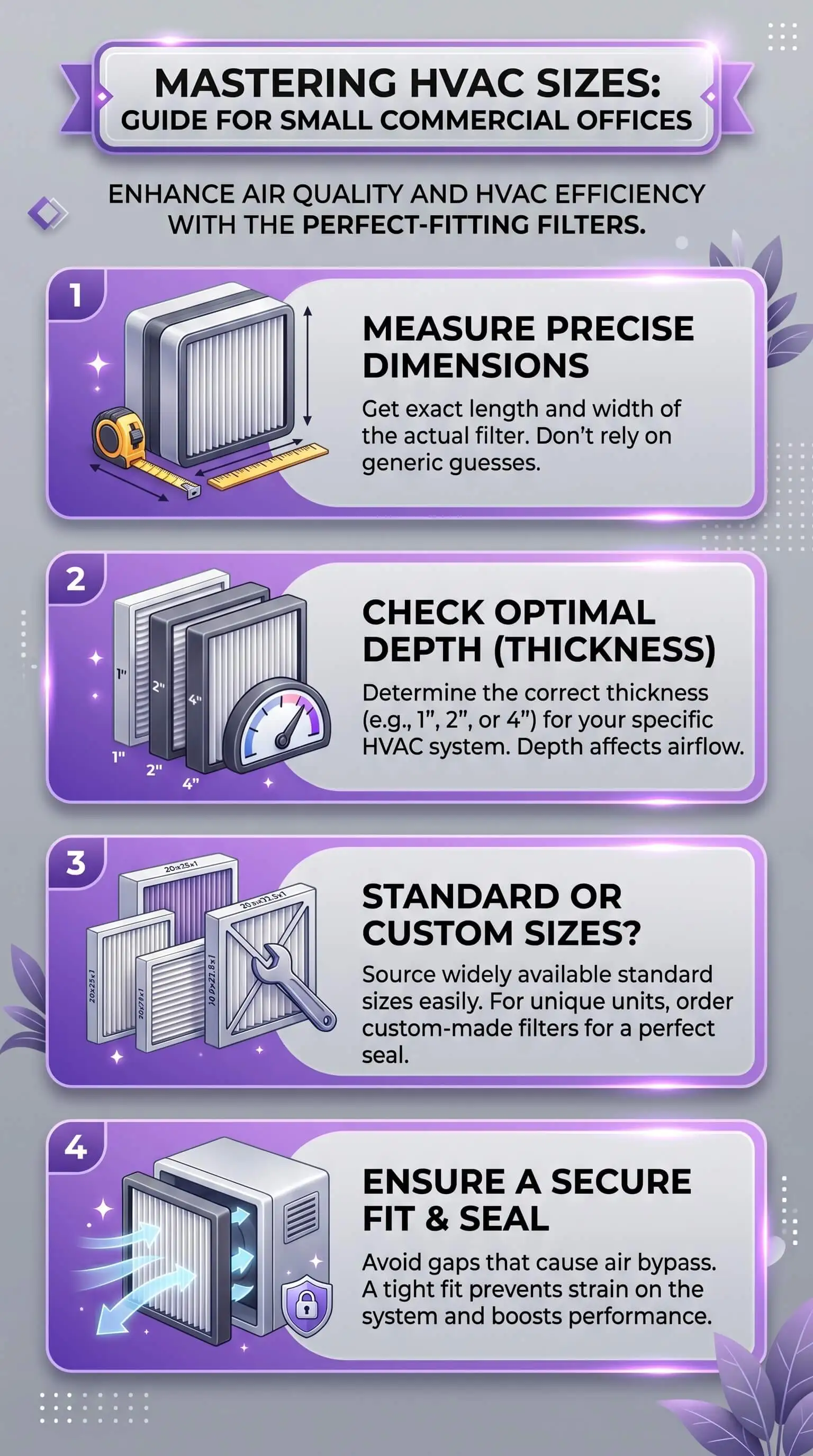
The number printed on the side of a filter, say 20x25x4, is the nominal size. The actual physical dimensions are smaller. Usually a quarter to a half inch on each side. A 20x25x4 nominal filter measures roughly 19.5 by 24.5 by 3.75 actual.
That's engineered on purpose. The actual size lets the filter slide into a 20x25 slot snugly without bending. Every filter manufacturer in North America uses the same convention, which is why filters get ordered by nominal size. The mistake we see most often: a property manager measures the slot at 19.5 by 24.5, orders that exact size, and ends up with a filter that's actually 19 by 24. Too small. Bypass on every side.
When in doubt, measure the slot opening, round up to the nearest standard nominal size, and order that. If the slot measures 19.75 by 24.75, the right order is 20x25.
MERV Rating Recommendations for Office Environments
MERV stands for Minimum Efficiency Reporting Value. It's the ASHRAE 52.2 scale that measures how well a filter captures airborne particles. The EPA recommends a minimum of MERV 13 for general office environments where the system can support it, with MERV 8 to 11 as the practical floor for older rooftop units that weren't built for higher resistance.
Here's the part most office managers don't hear from their HVAC contractor. Don't jump from MERV 8 to MERV 13 without verifying the unit's rated static pressure first. Over-filtration causes the same airflow problems as bypass: reduced cooling capacity, frozen evaporator coils in summer, and a blower motor that fails years early.
A safer upgrade path is to increase media depth before raising MERV. A 4-inch MERV 11 filter outperforms a 1-inch MERV 13 in most small commercial systems, because the deeper pleat surface area reduces pressure drop while still catching fine particles.
How to Confirm Your Office Filter Size in Under Three Minutes
Three steps. No special tools. One tape measure.
Shut down the unit at the thermostat for safety.
Pull the existing filter and read the nominal size printed on the frame edge. It's almost always the largest text on the side.
Verify by measuring the slot opening with a tape measure. If the printed nominal matches the slot to within a quarter inch in each dimension, that's the size.
Empty cabinets are surprisingly common in commercial buildings between tenant turnovers. If there's no filter in the slot to reference, measure the slot opening, use common furnace filter sizes as your starting point, round up to the nearest standard size, and that's the nominal. For non-standard slots common in 1970s and 1980s office construction, custom sizing is the cleanest fix.
"After manufacturing filters for office buildings across every climate zone in the U.S., the most expensive mistake we see is a property manager assuming the printed size on a filter frame matches the slot dimension. It doesn't. A quarter-inch of bypass on a small office RTU can wipe out every dollar spent on a higher MERV upgrade, regardless of what the filters made of might suggest. The filter that fits perfectly at MERV 11 will protect a workspace better than the filter that almost fits at MERV 13. Every time."
7 Essential Resources
These are the references our manufacturing and product teams come back to when sizing questions get complicated. Worth bookmarking before the next filter order.
1. EPA Guidance on MERV Ratings for HVAC Systems
The cleanest plain-language explanation of what MERV measures and why MERV 13 is the recommended target for occupied spaces. Worth reading before any office filter upgrade conversation with an HVAC contractor.
Source: epa.gov: What is a MERV rating?
2. EPA Guide to Air Cleaners Including HVAC Filter Fit
Direct guidance on filter fit, replacement intervals, and why a snug seal in the cabinet matters as much as the MERV rating itself. The fit guidance translates one-for-one from residential to small commercial.
Source: epa.gov: Guide to Air Cleaners in the Home
3. EPA Recommendations on Thicker HVAC Filters
Specific guidance on why 2-inch and 4-inch filters generally outperform 1-inch filters. The case for upgrading media depth before chasing higher MERV ratings in office environments.
Source: epa.gov: Air Cleaners, HVAC Filters, and Coronavirus
4. NAFA Commercial Filtration Selection Guide
The most authoritative commercial-specific reference on filter bypass, ASHRAE 52.2 testing, and how to evaluate filter efficiency for an office building specifically. Written for facility professionals, not consumers.
Source: nafahq.org: Selecting Proper Air Filter Efficiencies for Commercial Buildings
5. U.S. Department of Energy AC Maintenance Guidance
Official federal guidance on filter replacement cadence and the maintenance practices that keep commercial cooling systems running at rated capacity. The cadence guidance applies cleanly to small office RTUs.
Source: energy.gov: Air Conditioner Maintenance
6. EPA Indoor Air Quality Reference Page
Why filter sizing matters in the first place. Occupied office spaces concentrate the same pollutants employees would otherwise dilute outdoors. A useful page to send to a building owner who needs convincing that the filter line item is worth the spend.
Source: epa.gov: Indoor Air Quality
7. EPA Guidance on HEPA vs MERV
The clearest explanation of where MERV-rated HVAC filters end and HEPA begins. Most small office HVAC systems can't accommodate true HEPA, and this resource explains why and what to do instead.
Source: epa.gov: What is a HEPA filter?
3 Statistics
Three numbers worth knowing before the next filter conversation with a building owner or HVAC contractor.
1. Indoor Pollutant Concentrations Run Two to Five Times Higher Than Outside
Per the U.S. EPA, indoor concentrations of common pollutants are often two to five times higher than typical outdoor concentrations. For an office where employees spend the majority of their workday inside, that isn't a trivia stat. It's the case for treating filter sizing as a frontline indoor air quality control rather than a maintenance afterthought. From our manufacturing side, the same pollutants we capture in residential filters show up at higher concentrations in commercial filter samples we test, which tracks with the EPA finding.
Source: epa.gov: Introduction to Indoor Air Quality
2. A Clean, Correctly Sized Filter Cuts HVAC Energy Use by Up to 15 Percent
The U.S. Department of Energy reports that swapping a clogged filter for a clean one of the correct size can cut HVAC energy use by five to fifteen percent. For a small office running a 5-ton rooftop unit twelve hours a day in a hot climate, that's a meaningful line on the monthly utility bill, and the highest-ROI maintenance task we see customers schedule.
Source: energy.gov: Maintaining Your Air Conditioner
3. VOC Concentrations Run Two to Five Times Higher Indoors
EPA's Total Exposure Assessment Methodology research found concentrations of common volatile organic compounds run two to five times higher inside buildings than outside. During certain activities they spike to a thousand times outdoor levels. For small offices with off-gassing furniture, cleaning products, and laser printers running all day, that's the case for choosing a higher MERV rating where the system supports it. Finer filtration catches the particle-bound fraction of those VOCs.
Source: epa.gov: Volatile Organic Compounds Impact on Indoor Air Quality
Final Thoughts and Opinion
For most small commercial offices under 5,000 square feet, the right starting point is a 4-inch pleated MERV 13 filter in one of three nominal sizes: 16x25x4, 20x20x4, or 20x25x4, provided the rooftop or split system is rated to handle the static pressure. That's the recommendation we'd make to any property manager walking us through their building today.
The realistic exception: older RTUs with marginal blower capacity should stay at MERV 8 to 11 until a static-pressure test confirms there's headroom for an upgrade. There's no virtue in chasing the highest MERV number on the shelf if the unit can't move air through it. A filter that almost fits at MERV 13 will let more dust into the workspace than a filter that fits perfectly at MERV 11. Size first, MERV second. That's the order, and it doesn't change.
Frequently Asked Questions
Q: What are the most common air filter sizes for small commercial offices?
A: The most common nominal sizes for small commercial office HVAC are:
16x25x4: 3 to 5 ton split systems
20x20x4: compact rooftop units
20x25x4: 5 to 10 ton rooftop units
16x25x1 and 20x25x1: light commercial systems with 1-inch racks
24x24x2: drop-in ceiling cassette returns
Q: What is the difference between nominal and actual filter size?
A: Nominal is the rounded number printed on the filter frame. Actual is the precise physical dimension.
Actual size runs a quarter to a half inch smaller per side than nominal.
A 20x25x4 nominal filter measures roughly 19.5 by 24.5 by 3.75 actual.
Always order by nominal size. The actual size is engineered to fit the slot snugly without bending.
Q: What MERV rating should I use for an office building?
A: MERV 13 is the EPA-recommended target for general office environments where the system supports it.
MERV 8 to 11 is the realistic floor for older rooftop units with limited static-pressure headroom.
Confirm your unit's nameplate static pressure rating before jumping more than three MERV points.
Upgrading media depth from 1-inch to 4-inch at the same MERV is often a safer first move.
Q: How often should small office air filters be replaced?
A: Most small commercial offices should replace filters every 60 to 90 days.
Check filters monthly during peak cooling and heating seasons.
Higher occupancy, nearby construction, or heavy seasonal pollen accelerates the cadence.
Thicker 4-inch pleated filters generally last longer than 1-inch filters at the same MERV.
Q: Can I install a higher-MERV filter than my system was designed for?
A: Only if a static-pressure check confirms the system has the headroom for the additional resistance.
Over-filtration restricts airflow, strains the blower motor, and can freeze evaporator coils in summer.
Most small office RTUs were specified at MERV 8. Jumping to MERV 13 without verification is the most common mistake.
A safer upgrade path: increase media depth first, then raise MERV one or two steps at a time.
Q: What size filter does a 5-ton commercial rooftop unit use?
A: 5-ton small commercial RTUs most commonly use 20x25x4 or 20x25x2 nominal filters.
Some manufacturer-specific cabinets use 16x25x4 or two side-by-side 20x20x4 filters.
Always confirm by measuring the existing filter or the cabinet slot before ordering.
Custom sizing is available for non-standard older office cabinets.
Q: How do I measure my office HVAC filter slot?
A: Three steps:
Shut down the unit at the thermostat for safety.
Pull the existing filter and read the nominal size printed on the frame edge.
Verify by measuring the slot opening with a tape measure. If the slot measures 19.75 by 24.75, the right nominal order is 20x25.
Q: Do small offices need HEPA filters?
A: Most small office HVAC systems can't accommodate true HEPA filters.
True HEPA filters create static pressure beyond what most commercial RTU blowers can overcome.
MERV 13 catches the majority of fine particles and is the practical office standard.
If HEPA-grade filtration is needed for a specific use case, supplement with portable HEPA air cleaners rather than retrofitting the HVAC system.
CTA
Need help confirming the right size for your office? Browse the complete air filter size guide to match your unit, or reach out for a custom-sized filter built to the exact dimensions of your cabinet. For offices with non-standard older equipment, custom is often the only way to get a true snug fit and stop the bypass that quietly costs the building money every month.