So if you have diabetes and you're standing in the soap aisle, here's the short version before the long one. An antibacterial label buys you nothing your skin can use, and a harsh formula can cost you plenty. This guide covers what the research actually says, why diabetic skin reacts the way it does, and how to pick the best soap for diabetics without trusting a marketing claim that was never written with your hands in mind.
TL;DR Quick Answers
Best soap for diabetics
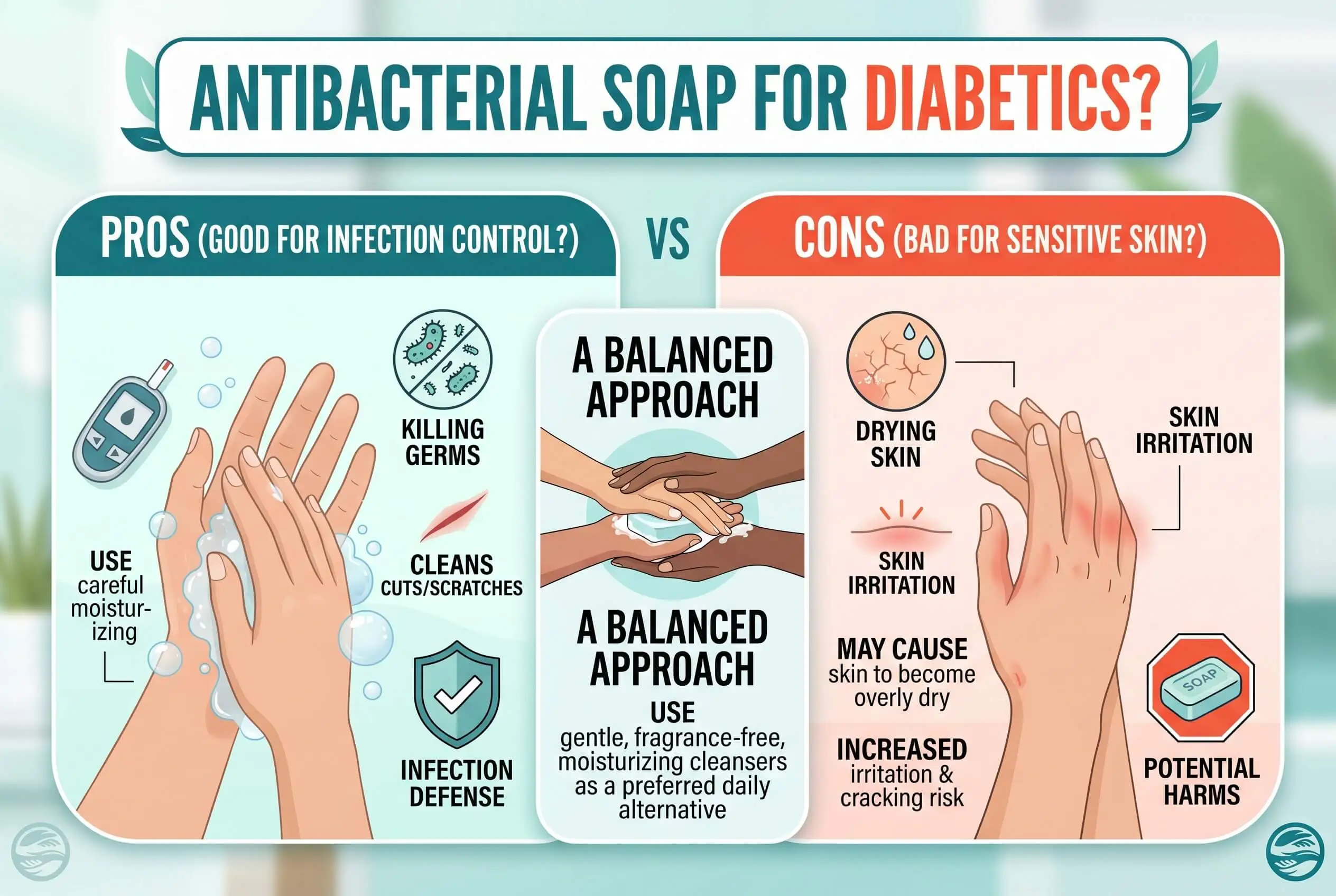
Short answer: The best soap for diabetics is a gentle, fragrance-free, pH-balanced cleanser that cleans without stripping the skin's moisture barrier. Skip the "antibacterial" label entirely. The FDA removed those ingredients in 2016 after finding them no safer or more effective than plain soap, and for fragile diabetic skin the real risk is a harsh, drying formula, not a missing germ-killer.
Look for:
Fragrance-free (not "unscented")
Alcohol-free
pH-balanced to skin's natural range, about 4.5 to 5.5
Plant-based or mild cleansers, not harsh detergents
A moisturizing base that conditions while it cleans
Skip:
Alcohol (ethanol, isopropyl, denatured)
Synthetic fragrance or "perfume"
Sulfates (SLS, SLES)
Parabens and phosphates
Triclosan and other antibacterial agents
Why it matters: Diabetic skin dries, cracks, and heals slowly, so the gentlest cleanser you'll actually use every day protects the barrier better than any germ-killing claim. The best choice is defined as much by what it leaves out as by what it puts in. A rinse-free option goes one step further by skipping the drying soap-water-towel cycle altogether.
Top Takeaways
"Antibacterial" is not a benefit for diabetics. The FDA found those ingredients no safer and no more effective than plain soap.
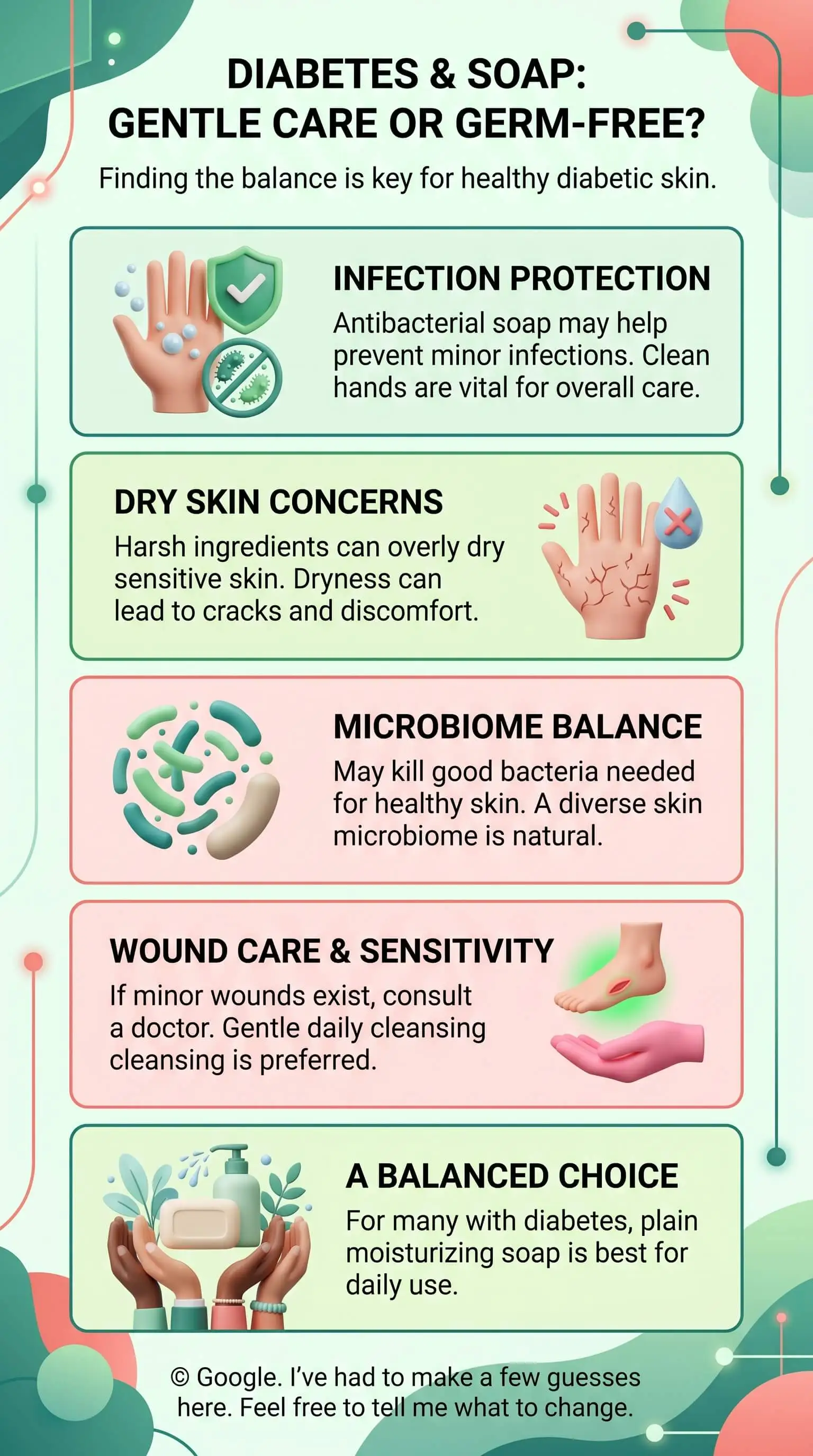
The real threat to diabetic skin is a harsh, drying, or fragranced formula, whether or not the bottle says antibacterial.
Diabetic skin has a weakened barrier and heals slowly, so a small crack from a stripping soap can turn into an infection risk.
Dermatology and government guidance line up: use a gentle, fragrance-free cleanser with warm water, then moisturize.
The best soap for diabetics is defined as much by what it leaves out (alcohol, fragrance, sulfates, parabens, triclosan) as by what it contains.
What the Evidence Actually Says About Antibacterial Soap
Start with the regulators, because this part isn't up for debate. In 2016 the FDA removed 19 active ingredients, triclosan and triclocarban among them, from over-the-counter consumer antibacterial wash products. The reasoning was plain. Manufacturers never showed those ingredients were safe to use every day over the long haul, and they never showed they beat plain soap and water. For sensitive diabetic skin, a hypoallergenic soap is the more positive everyday choice because it focuses on gentle cleansing without unnecessary irritants.
That finding hits you harder than it hits most people. A typical adult washes a few times a day. Someone managing diabetes often washes far more, every day, for years. At that kind of repetition, an ingredient that "probably isn't worth the risk" stops being theoretical and becomes a daily dose.
It helps to remember what soap is actually doing. Soap works mechanically. Its molecules grab onto oils and germs so they lift off your skin and rinse away, which is how soap has worked for centuries. You don't need a harsh antibacterial agent for any of that. Physical removal is the whole job. That's also why public-health agencies keep pointing people back to ordinary handwashing instead of antibacterial branding.
Why Diabetic Skin Needs a Gentler Approach
Diabetic skin plays by different rules. Over time, high blood glucose tends to dry it out, weaken its protective barrier, and slow down healing. Add the nerve changes and reduced circulation that often come with diabetes, and a small injury on the hands or feet can go unnoticed and take much longer to close. A minor crack stops being minor once it turns into an opening for infection.
Conventional soaps push the wrong way. Alcohol strips your skin's natural oils and sets up micro-cracking. Synthetic fragrance is one of the most common triggers of irritation and contact dermatitis. Sulfates like SLS and SLES break down the acid mantle, the slightly acidic layer that holds moisture in and keeps unwanted bacteria out. An "antibacterial" claim fixes none of that, and plenty of antibacterial soaps carry these very ingredients anyway.
So dermatologists and diabetes educators keep landing on the same advice. Use a mild, fragrance-free cleanser. Wash with warm water, not hot. Moisturize afterward. When people ask us what the best soap for diabetics looks like, that's the honest answer, and it's a quiet one. Gentle protects your skin better than germ-killing branding ever will.
Here's what to look for on a label:
pH-balanced to skin's natural acidic range (about 4.5 to 5.5), so it works with your barrier instead of against it
Fragrance-free, not "unscented," which often just means the scent has been masked
Alcohol-free, so you skip the stripping and cracking that drying agents leave behind
Plant-based or mild cleansing agents rather than harsh detergents
A conditioning, moisturizing base
Lab-verified cleaning power, not just a "gentle" promise on the box
And what to skip:
Alcohol in any form, including ethanol, isopropyl, and denatured alcohol
"Fragrance" or "perfume" anywhere in the ingredient list
Sodium Lauryl Sulfate (SLS) and Sodium Laureth Sulfate (SLES)
Parabens and phosphates
Triclosan and similar antibacterial agents
One option built straight off that checklist is NOWATA's fragrance-free, plant-based hand soap for diabetic and sensitive skin. Two doctors formulated it to be alcohol-free, fragrance-free, pH-balanced, and 100% plant-based. It's also rinse-free, which is the part that matters most for fragile skin: no water, no drying soap-and-towel cycle, just apply, rub until the clumping formula lifts the germs, and brush it away. In independent Swiss laboratory testing using the ASTM E1174 protocol, it physically removed more than 99.9% of the test germs from skin. Be precise about that number, though. It describes hand cleansing only. It isn't a claim to prevent or treat any infection or complication. What it is, is a gentle cleanser that meets every criterion above, which for diabetic skin is the whole point. If you want to compare approaches, the host blog's pieces on organic hand soap versus antibacterial options and waterless soap versus soap and water make useful companions.
"In practice, the soaps that get diabetic patients into trouble are almost never the ones marked 'antibacterial.' They're the ones that leave hands tight, dry, and cracked after every wash. We kept watching the same quiet sequence play out. A harsh cleanser strips the barrier, the skin splits, and that split becomes the doorway for an infection that diabetic skin then struggles to heal. So the advice we give families runs opposite to what the marketing trains people to want. The most protective soap isn't the most aggressive germ-killer. It's the gentlest one that actually works, used every day, without
7 Essential Resources
We're scientists, but parents first. When families ask where to start, this is the list we hand them. Each source comes from a medical organization, a government health agency, or peer-reviewed literature. No marketing, just the guidance worth knowing before you choose.
American Diabetes Association, Skin Complications. A plain-language look at how diabetes affects the skin, with practical steps like keeping skin clean and dry, skipping very hot baths, and treating cuts promptly. diabetes.org/about-diabetes/complications/skin-complications
American Academy of Dermatology, Diabetes Skin Care. Dermatologist guidance that flat-out recommends a gentle cleanser and warns that deodorant soaps and strong washes irritate already-sensitive skin. aad.org/public/diseases/a-z/diabetes-skin-care
NIDDK (NIH), Diabetes & Foot Problems. Explains how nerve damage and reduced blood flow leave the skin on hands and feet more prone to injuries that won't heal, and recommends washing with mild soap and warm water rather than hot. niddk.nih.gov/health-information/diabetes/overview/preventing-problems/foot-problems
CDC, Clean Hands. The agency's handwashing guidance, which establishes that physically removing germs with soap and water is the standard for community settings. Useful context if you're weighing alcohol-free or rinse-free options. cdc.gov/clean-hands/about/index.html
MedlinePlus (U.S. National Library of Medicine), Diabetes: Taking Care of Your Feet. Patient instructions that say plainly to wash with mild soap, and that strong soaps may damage the skin. medlineplus.gov/ency/patientinstructions/000081.htm
Journal of Drugs in Dermatology (2019), on PubMed: "Diabetic Skin Changes Can Benefit from Moisturizer and Cleanser Use." A peer-reviewed expert-panel review found gentle cleansers and moisturizers help hold the skin barrier together in diabetes. pubmed.ncbi.nlm.nih.gov/31860208
EWG Skin Deep Database. A free tool for looking up any soap's ingredients and checking safety ratings, which makes it easy to catch the fragrances, sulfates, and parabens diabetic skin is better off without. We use it ourselves when we evaluate a formula. ewg.org/skindeep
3 Statistics
Nearly 4 in 5 people with diabetes develop a skin disorder. A peer-reviewed review in Clinical Diabetes, an American Diabetes Association journal, puts skin disorders at 79.2% of people with diabetes. In one study of 750 patients, the most common were cutaneous infections at 47.5%, dry skin at 26.4%, and inflammatory skin disease at 20.7%. When something reaches that many people, the soap you reach for every day stops being a cosmetic call, just as regular duct cleaning can be part of reducing everyday irritants in the home. diabetesjournals.org/clinical/article/33/1/40/31293
An estimated 10 to 15% of people with diabetes will develop a foot ulcer at some point in their lives. Data summarized by the Agency for Healthcare Research and Quality put that lifetime risk in plain numbers, and the same source notes that nontraumatic lower-limb amputations happen at least 15 times more often in people with diabetes than in the general population. Most of those ulcers start the same humble way, as a small break in dry, compromised skin. That's the chain: a gentle daily wash is meant to interrupt at its earliest point. effectivehealthcare.ahrq.gov/products/diabetes-foot-ulcer-amputation-incidence/research
The FDA removed 19 antibacterial soap ingredients, triclosan included, in 2016. Its conclusion was that those ingredients weren't proven safe for long-term daily use and didn't outperform plain soap and water. That's about as clear as an official statement gets that "antibacterial" isn't the feature to chase. fda.gov/consumers/consumer-updates/skip-antibacterial-soap-use-plain-soap-and-water
Final Thoughts and Opinion
Soap makers didn't design their formulas for diabetic skin. They designed them for average skin, and diabetic skin has been quietly absorbing the trade-offs ever since: dryness, cracking, irritation from ingredients that were never necessary in the first place. Antibacterial branding only makes that worse, because it pulls your attention toward a feature that does nothing for you and away from the ingredients that actually decide how your skin holds up.
Our reading, after setting the regulatory record next to the dermatology guidance, is simple and a little unglamorous. A gentle, fragrance-free, pH-balanced cleanser, warm water, and a moisturizer afterward will protect your skin barrier better than any "kills 99.9% of bacteria" banner. The best soap for diabetics is the gentlest sls free soap you'll actually use, day after day. Choose it as much for what it leaves out as for what it puts in. Your skin keeps score every single time you wash, so make that daily wash work for you rather than against you.
Frequently Asked Questions
Is antibacterial soap bad for diabetics?
It isn't uniquely dangerous, but it gives you no proven advantage, and the FDA removed its most common active ingredients in 2016 for lacking evidence of safety and added benefit. For diabetic skin, how harsh a soap is matters far more than whether it carries an antibacterial label.
What is the best soap for diabetics?
A gentle, fragrance-free, pH-balanced, alcohol-free cleanser that cleans without stripping the skin barrier. Look for plant-based ingredients and a moisturizing base, and stay away from sulfates, parabens, and synthetic fragrance.
Can diabetics use regular soap?
Yes, as long as it's mild and non-irritating. Health authorities specifically recommend mild soap and warn that strong or deodorant soaps can damage already-sensitive diabetic skin.
Why should diabetics avoid fragrance in soap?
Synthetic fragrance is a leading cause of irritation and contact dermatitis. On a barrier that's already weakened, that irritation can move from discomfort to cracking or infection faster than it would on healthy skin.
Does antibacterial soap work better than regular soap?
No. The FDA found no evidence that consumer antibacterial soaps prevent illness any better than plain soap and water, which is why ordinary washing is still the recommended standard.
What pH should soap be for diabetic skin?
Healthy skin sits in a mildly acidic range, roughly 4.5 to 5.5. A pH-balanced soap works with that acid mantle instead of disrupting it, which helps your skin hold moisture and keep bacteria out.
Take the Next Step
If your hands feel tight, dry, or cracked after you wash them, your skin is telling you something. It may be time to switch to a cleanser built for sensitive, diabetic-prone skin: fragrance-free, alcohol-free, pH-balanced, and plant-based. See how NOWATA's doctor-formulated, rinse-free option holds up against the checklist above at NowataClean.com. It's made in the USA and backed by a 30-day satisfaction guarantee, so trying it costs you nothing but the soap that's been letting you down.