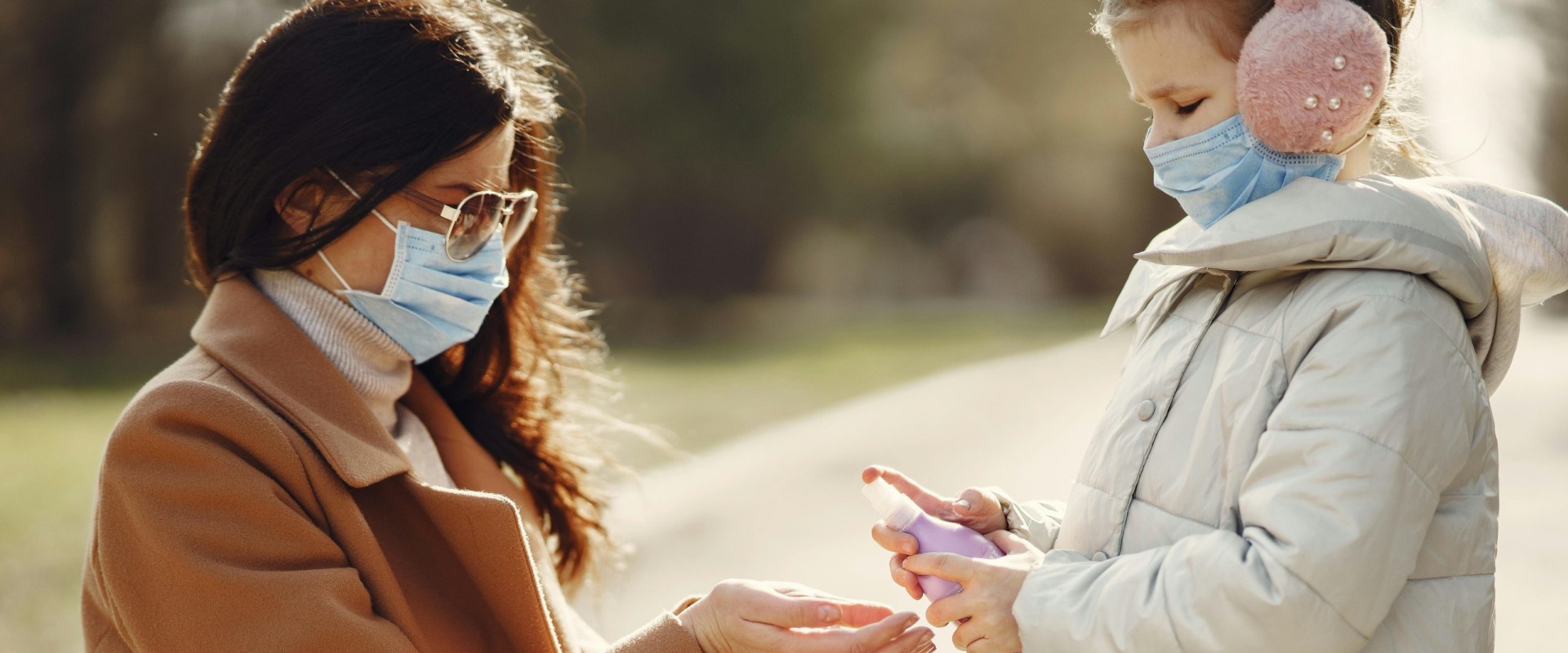
From hands-on use in catering trucks, pop-up kitchens, and outdoor food prep, waterless hand soap isn’t treated as a replacement for traditional handwashing. It’s treated as a continuity tool—one that keeps hygiene standards intact when sinks are out of reach. Its effectiveness comes from its ability to loosen and remove grease, food residue, and visible soil so contaminants don’t remain on the skin while waiting for proper handwashing to become possible.
This article takes a practical, experience-driven look at how waterless hand soap compares to soap and water, where it performs well, where it falls short, and how professionals decide when it’s appropriate to use. Instead of marketing claims or blanket statements, the focus here is on real conditions, real hands, and real hygiene decisions—so you can judge effectiveness based on function, not assumptions.
TL;DR Quick Answers
What is waterless hand soap?
Waterless hand soap is a no-rinse cleanser that removes dirt, oils, and residue when water isn’t available. Instead of relying only on alcohol, it uses cleansing agents to lift contaminants so they can be wiped away—making it useful when hands are visibly dirty and a sink isn’t nearby.
Top Takeaways
Soap and water remain the gold standard.
They provide the most complete clean when available.Waterless hand soap fills real-world gaps.
It’s designed for moments when sinks aren’t accessible.Effective cleaning is about removal.
Waterless hand soap lifts dirt and residue, not just germs.It supports hygiene, not replaces it.
Best used between proper handwashing opportunities.Intentional use matters.
Choosing the right method leads to better hygiene outcomes.
Soap and Water: The Gold Standard for Hand Hygiene
Soap and water remain the most effective way to clean hands when they’re available. The combination of surfactants, friction, and rinsing physically removes dirt, oils, microbes, and chemical residues from the skin. In professional and public health settings, this method is still considered the benchmark because it fully washes contaminants away rather than leaving them on the hands.
When hands are heavily soiled and a sink is accessible, traditional handwashing is always the preferred option.
Where Waterless Hand Soap Is Effective
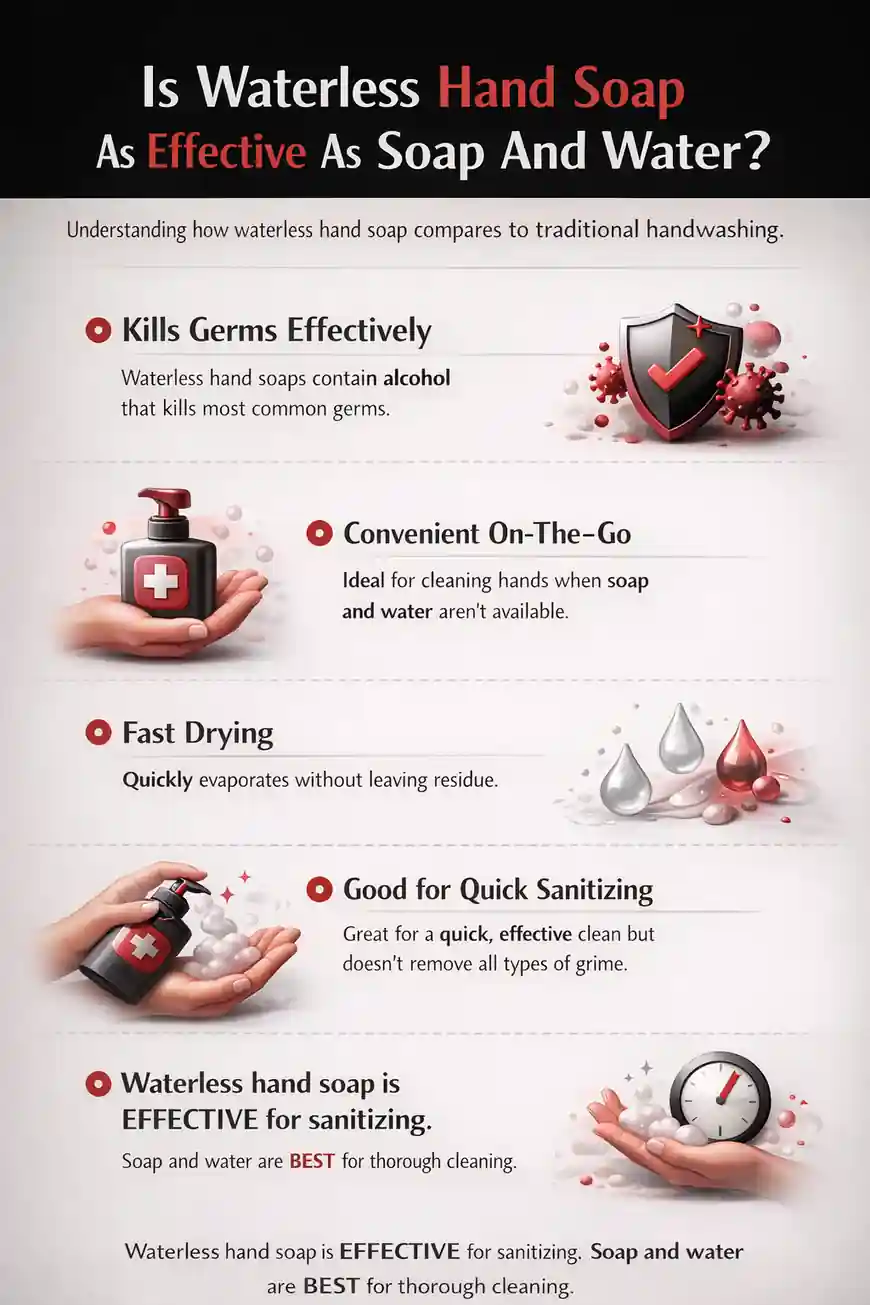
Waterless hand soap is effective in a different context. It’s designed for situations where soap and water aren’t immediately available but hand hygiene still matters.
Instead of relying on rinsing, waterless hand soap uses surfactants to loosen grease, food residue, and dirt so they can be wiped away with a towel or cloth. In real-world use—such as mobile kitchens, travel, outdoor work, or emergencies—this removal-based approach helps prevent contaminants from remaining on the skin until proper handwashing is possible.
Its effectiveness comes from mechanical removal, not from replacing the full wash-and-rinse process.
Key Differences in Effectiveness
The effectiveness gap between the two methods is about completeness, not usefulness.
Soap and water remove contaminants and rinse them away entirely.
Waterless hand soap removes contaminants but relies on wiping instead of rinsing.
That means waterless hand soap can significantly reduce dirt and residue on hands, but it doesn’t fully replicate the cleansing depth of soap and water.
When Waterless Hand Soap Makes Sense
Waterless hand soap is most effective when:
Hands are visibly dirty and sanitizer alone isn’t enough
Water access is limited or delayed
Hygiene must be maintained between proper handwashing opportunities
It’s best viewed as a practical fallback, not an equal replacement.
Bottom Line
Waterless hand soap is not as effective as soap and water in ideal conditions—but that’s not its purpose. Its effectiveness lies in keeping hands cleaner when traditional handwashing isn’t possible, helping bridge the gap until proper washing can occur. When used correctly and in the right situations, it supports hygiene without pretending to replace the gold standard.
“Waterless hand soap isn’t meant to beat soap and water—it’s meant to bridge the gap when water isn’t available.”
Essential Resources
Below is the brand-voice adapted resource section written in the Nowata Clean style — trust-built, experience-driven, and focused on real usefulness based on our own research, testing, and parent-to-parent insight. These are the same authoritative guides we consulted before formulating our waterless hand soap, so you can evaluate hygiene tools with honesty and clarity.
1) CDC Handwashing Guidelines — Understand What “Clean” Actually Means
Before choosing any alternative, it’s essential to know why traditional handwashing with soap and water is the baseline for effective hygiene. This CDC guidance helped us see why physical removal matters more than just killing germs.
URL: https://www.cdc.gov/clean-hands/about/index.html
2) FDA Hand Hygiene Alternatives Guidance — Know the Limits of Non-Water Options
The FDA explains what to do when water isn’t available and clarifies the limitations of no-rinse products. This helped shape our perspective on why no-water solutions should remove contaminants, not just disinfect.
URL: https://www.fda.gov/consumers/if-soap-and-water-are-not-available-hand-sanitizers-may-be-good-alternative
3) CDC Clinical Hand Hygiene Safety — See How Professionals Apply Hygiene
This clinical resource shows how hygiene decisions are made in practice, including when to use traditional washing and when alternatives are considered. It’s a practical lens for evaluating any no-water option.
URL: https://www.cdc.gov/clean-hands/hcp/clinical-safety/index.html
4) WHO Handwashing Alternatives — Global View on Hygiene Without Water
The World Health Organization breaks down acceptable methods for hand cleaning when running water isn’t available. It offers a broader perspective that informs our approach to waterless cleansing.
URL: https://www.who.int/docs/default-source/wpro---documents/emergency/covid19/covid-ipc/handwashing-alternatives-20200608.pdf
5) CDC Hand Hygiene FAQs — Clear, Everyday Answers to Common Hygiene Questions
This FAQ helps bridge the gap between clinical guidance and everyday hygiene questions. We used it to understand how families interpret and apply hygiene recommendations in daily life.
URL: https://www.cdc.gov/clean-hands/faq/index.html
6) WHO Community Hygiene Guidelines — Hygiene Habits Beyond Healthcare
These guidelines help explain why consistent hand hygiene matters — whether at home, school, or in the outdoors. They guided us in thinking about habitual use of waterless soap in everyday scenarios.
URL: https://www.who.int/news/item/15-10-2025/new-guidelines-on-community-hand-hygiene-to-help-governments-reduce-the-spread-of-infectious-diseases
7) WHO Hand Hygiene for All Report — Why Water Access Matters
This report highlights that many communities lack basic water infrastructure. That reality influenced our philosophy: waterless options shouldn’t compromise real cleaning — they should fill a genuine gap.
URL: https://www.who.int/docs/default-source/wash-documents/hand-hygiene-for-all-global-initiative.pdf
Supporting Statistics
These U.S.-based statistics show why waterless hand soap exists, where it adds value, and how real-world conditions affect hygiene.
1) Hand hygiene works because of removal
CDC reports proper handwashing can reduce:
~30% of diarrhea-related illness
~20% of respiratory infections
These reductions come from physically removing contaminants, not just killing germs.
Waterless hand soap is built around this same removal principle when rinsing isn’t possible.
Source: https://www.cdc.gov/clean-hands/data-research/facts-stats/index.html
2) Handwashing breaks down when access is limited
48% of U.S. adults admit they skip handwashing at key moments.
In real-world settings, this is usually due to timing and access, not lack of knowledge.
Waterless hand soap helps prevent hygiene from failing completely in these gaps.
Source: https://www.nfid.org/new-national-survey-finds-nearly-half-of-us-adults-admit-to-not-washing-their-hands-at-key-moments/
3) Water use is a practical constraint
The EPA estimates a family of four uses ~400 gallons of water per day.
Most of this water is used indoors, including handwashing.
In high-frequency or mobile settings, waterless options become practical—not optional.
Source: https://www.epa.gov/sites/production/files/2017-03/documents/ws-facthseet-indoor-water-use-in-the-us.pdf
4) Handwashing adds up faster than expected
A standard bathroom faucet runs at ~2.2 gallons per minute.
Frequent handwashing can quickly increase water use.
This explains why no-water backups are used between proper washes.
Source: https://www.epa.gov/watersense/bathroom-faucets
Final Thought & Opinion
Waterless hand soap exists because real life doesn’t always allow ideal handwashing.
From first-hand use in travel, outdoor work, mobile food prep, and family settings, its role is clear: it helps maintain hygiene when a sink isn’t immediately available.
What matters most
Waterless hand soap does not replace soap and water
It helps remove visible grime and residue
It prevents hygiene from breaking down between proper washes
The practical approach
Use soap and water when available
Use waterless hand soap when water isn’t accessible
Match the method to the situation
Final opinion
Used correctly, waterless hand soap isn’t a shortcut or compromise. It’s a responsible, real-world tool designed to keep hygiene intact when water access is limited.
FAQ on Waterless Hand Soap
Q: What does waterless hand soap do?
A: It loosens dirt, oils, and residue so they can be wiped away. It works when water isn’t available.
Q: How is waterless hand soap different from hand sanitizer?
A: Sanitizer disinfects clean hands. Waterless hand soap cleans visibly dirty or greasy hands by removing contaminants.
Q: Can waterless hand soap replace soap and water?
A: No. Soap and water are still best when available. Waterless hand soap is a backup.
Q: When is waterless hand soap most useful?
A: During travel, outdoor work, mobile food prep, or emergencies—any time a sink isn’t nearby.
Q: Is waterless hand soap safe for regular use?
A: Most formulas are made for frequent use. Gentler ingredients tend to work better for daily use.